
SAY GOODBYE TO GLUTEN: OVER 200 CLINICALLY CONFIRMED REASONS TO AVOID WHEAT
 by: PF Louis,
(NaturalNews) This title is the same as a recent GreenMedInfo.com. It contains a list of over 200 health problems, with celiac disease at the top and including many more not normally associated with gluten intolerance.
The author and founder of GreenMedInfo.com, Sayer Ji, prefers the term gluten toxicity to gluten sensitivity or gluten intolerance… “in order to shift the focus away from the victim back to the aggressor, the gluten itself.”
Sayer Ji’s GreenMedInfo.com article lists all the disorders linked to gluten. They are hyperlinked to articles and abstracts of clinical studies recorded in MedLine since 1971.
EXPLAINING THE ATTACK ON WHEAT AND OTHER GRAINS
Negative reports on wheat and other grains have risen considerably in the past decade. The dramatic rise of celiac disease, a chronic gut inflammation that destroys intestinal villi (tiny tubes) responsible for absorbing nutrients, has been a major focus.
The gluten toxicity that brings on Celiac disease and other autoimmune reactions is mostly from peptides contained in gluten known as gliadin proteins, which damage the intestinal tract.
In addition to Celiac disease, which if undetected leads to malnutrition that creates other diseases, gluten toxicity can result in several other manifestations of poor health, including chronic fatigue and mental disorders.
Lectins, sticky proteins common to all plants for self defense, are a prominent feature of wheat germ agglutinin (WGA). In addition to flattening out intestinal villi and causing Celiac, they can penetrate gut linings and create leaky gut.
Once lectins get into the blood stream, they can bind to leptin receptors, blocking the leptin sensitivity that lets you know you’ve had enough to eat, creating a sluggish metabolism, and disrupting insulin balance. In other words, it leads to obesity and diabetes.
So how did the “staff of life” become a weed of disease?
For starters, wheat is not the same today. It has been hybrid over time to resist fungus, grow more quickly, and be more pliable for industrial bread baking. 50 years or so ago, wheat contained only five percent gluten. Today, it is 50 percent gluten.
The food industry’s concern for production efficiency and perception of consumer demands has focused on the bottom line with the usual disregard to the negative health consequences of fellow humans. Breads and other baked goods are hastily produced with additives and short cuts that are actually toxic.
In the UK, some of Europe, and North America, slightly different high speed methods of baking evolved over time. By adding “improvers” with usually toxic additives and mixing the dough violently, loaves of bread could be baked, cooled, and packaged within a few short hours.
Agricultural resources then sped up the hybrid process for wheat to accommodate the baking industry’s mechanical requirements of pliable proteins, leading to the 10-fold increase of wheat’s gluten since that time.
This situation has permeated almost all nations. There are some exceptions; for instance, most of Europe doesn’t permit chemically bleaching flour to produce white bread. They use sunlight to “bleach” wheat.
HAVING YOUR CAKE AND EATING IT TOO
Not all of us are prepared to go strictly Paleo and exclude all grains and legumes. Some of us still prefer not to eat animals, and if the food supply bottom falls out, many aren’t ready and able to kill and skin deer or other animals to survive.
Grains such as rice and dried legumes are easy to hoard and use for survival if the store shelves become empty overnight. The common concern for rice and legumes is phytates or phytic acid, which can block minerals from being absorbed in our bodies.
Overnight soaking, a prerequisite for cooking dry beans, has been known to minimize phytates, or phytic acid. Rice can be soaked overnight as well. The process of cooking itself reduces phytic acid.
Using sprouted wheat flour can ameliorate some of WGA’s toxicity. Baking with sourdough starters instead of normal baker’s yeast can help also, while combining both may be optimum (http://www.foodrenegade.com). It appears Whole Foods bakery does so.
Wheat’s gluten toxicity is reduced by sourdough starters properly fermented for 24 hours or more. A University of Alberta Canadian cereal microbiologist, Michael Gaenzle, suggests that sourdough bread, homemade or from a trusted bakery, may be at least a solution for gluten toxicity.
He referred to a study where recovered Celiac patients suffered no consequences from eating fermented (sourdough) wheat bread for two days. Those who ate regularly produced wheat bread did have a relapse.
http://myscienceacademy.org/2012/10/17/say-goodbye-to-gluten-over-200-clinically-confirmed-reasons-to-avoid-wheat/
Decoding Labels: Oroweat 100% Whole Wheat Bread
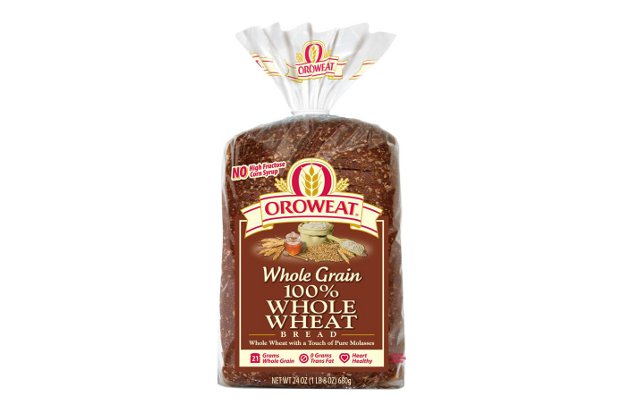
Bread is a contentious subject in the health food community these days. Low-carbers argue that all bread is evil because it’s high in carbohydrates. Paleo dieters argue that bread is evil because it’s made with neolithic grains that your body isn’t adapted to digesting. Fans of Wheat Belly argue that modern wheat is evil because it’s been so hybridized it’s no longer actually healthy for us. Others aren’t against bread, per se, but are against bread containing gluten.
But if you’re a health-conscious bread eater, chances are you stick to whole grain breads. You buy a loaf of sandwich bread that claims to be “Whole Wheat” or “Whole Grain.” You may have even boughtOroweat’s 100% Whole Wheat Bread.
While I do little cooking with grains anymore, it’s mostly out of laziness and not any abiding belief that grains are evil. That’s because I’ve researched how successful traditional cultures around the world eat grains. And trust me, they do — and these successful societies are HEALTHY.
Almost all traditional food cultures treat their grains through one of two methods — sprouting or fermenting. Sometimes they do a combination of the two. I’ve written before about How to Eat Grains, so I don’t want to repeat myself here.
The point is, I enjoy grain-free cooking because I don’t want to go through the effort of nurturing a sourdough culture or sprouting all my grains. Some of you may be avoiding grains for health reasons. More power to you! If you’ve got digestive issues, or some hormonal issues, or weight issues, or neurological issues, I strongly believe that going grain-free can be a critical part of your healing protocol.
But for the rest of us, grains aren’t evil. And because we choose to eat grains, we want to buy bread that will be good for us and our families.
So, let’s check out Oroweat’s 100% Whole Wheat Bread and see just how good for us it is.
Here’s what the manufacturer claims:
Our 100% whole wheat bread is made with whole grains, is a good source of fiber and every slice adds hearty flavor to sandwiches and more. No high fructose corn syrup. No artificial colors or flavors. 22g whole grains per serving.
Whole grains are good! Fiber is good! And who doesn’t love hearty flavor? So far, this is looking pretty good. AHA! No high fructose corn syrup. SCORE! No artificial colors or flavors sounds like a good thing, too.
Oroweat 100% Whole Wheat Bread: Ingredients
- WHOLE WHEAT FLOUR,
- WATER,
- SUGAR,
- WHEAT GLUTEN,
- YEAST,
- RAISIN JUICE CONCENTRATE,
- WHEAT BRAN,
- MOLASSES,
- SOYBEAN OIL,
- SALT,
- MONOGLYCERIDES,
- CALCIUM PROPIONATE (PRESERVATIVE),
- CALCIUM SULFATE,
- DATEM,
- GRAIN VINEGAR,
- CITRIC ACID,
- SOY LECITHIN,
- WHEY,
- NONFAT MILK
Oroweat 100% Whole Wheat Bread: DECODED
Whole Wheat Flour isn’t as innocuous as it sounds. On the one hand, it’s made from whole grains. In almost all cases, whole grains are preferable to refined grains. So, whole wheat flour is a good thing, right? Except this industrially-produced flour leaves much to be desired.
Those who mill their own flour (as I do when I use it), know one thing for certain. Freshly milled, totally unprocessed whole grain flour goes bad within 5-7 days. So how do the whole grain flours on store shelves and used in store-bought baked goods last so long? Many claim to stay fresh for 4-6 months.
In truth, they’re likely to treat the grains or flours in some way that extends shelf life. Often grains are irradiated, brominated, bleached or unbleached. Some things that sound good, like “unbleached,” really just mean that the flour was treated with something else — like potassium bromate or iodate. The point is, these so-called healthy whole grain flours are usually bitter tasting, oxidized, and just plain bad chemical maelstroms.
Water doesn’t bring to mind any objections.
Sugar, however, is likely refined white table sugar made from GMO sugar beets.
Wheat gluten is not necessarily bad, but it is questionable. It’s added to whole grain breads to help them rise better. That’s because we’ve gotten used to fluffy white breads (which are higher in gluten since the bran has been removed). This added gluten can contribute to growing gluten sensitivities, so it’s not really all that desirable.
Yeast is an integral part of any bread, right? But there’s a difference between wild, naturally-occurring yeasts found in traditional sourdough cultures and the newly-invented baker’s yeast. Before the advent of industrial food processing, yeast had to be cultured in ferments. This is how traditional sourdough ferments are made, as well as beer or other alcohol ferments. Traditional sourdough loaves would take anywhere from 12 hours to a few days to ferment and fully rise. With the invention of industrial centrifuges, yeast cultures could be concentrated to a degree never before known. Now bread that used to take days to make could take a few hours. Is this inherently unhealthy? I think the jury’s still out on that. What I do know is that I have an inherent distrust of industrial foods, including industrial yeast.
Raisin Juice Concentrate is included for flavor and sweetness, as is Molasses.
Wheat bran is likely added to increase the fiber content of the bread and help create the “whole wheat” color that the public expects.
Soybean oil is a sad tribute to industrial food. It is likely made from GMO soybeans. BOO! And, it’s also a product of industrialization. Until we created high-temperature, high-pressure extraction methods at the turn of the last century, most seed oils weren’t available to us. They have no place in the human diet, and their high concentration of rancid or oxidized polyunsaturated fatty acids makes them hotbeds for promoting weight gain and cancer.
Now let’s investigate the chemical cocktail of ingredients towards the end of this list.
Monoglycerides are a type of fat, but in most industrial food uses they’re synthetically manufactured. In this case, they are added to thicken the bread, to make it lighter and softer.
Calcium Propionate is an anti-fungal that’s added to the bread to prevent mold growth. This is one of the primary reasons why your loaf of store bought bread can sit on your counter for weeks without going bad. It has been linked to the formation or exacerbation of stomach ulcers, migraine headaches, and mood disorders in children.
Calcium sulfate is something you may know by it’s crafty name — Plaster of Paris. When used in baking, it acts as a dough conditioner to help the dough not be soft and sticky. At home, you’d simply add flour or eggs to accomplish the same texture. In industry, adding calcium to the bread removes the stickiness without the need for these costly ingredients. Most other forms of calcium, like calcium phosphate, leave a chalky taste in the mouth. Industrial bakers can get away with using more calcium sulfate because its taste is less noticeable.
DATEM is short for Diacetyl Tartaric Acid Esters of Monoglycerides. It’s added to act as an emulsifier that strengthens the gluten in high-fiber, whole grain breads. It helps make the crust a bit “crustier” and less spongy. Of course, traditionally made breads will get crusty all on their own, without the added chemical.
Adding Grain Vinegar to the dough helps it rise faster and helps give it the slightly sour taste, as does the Citric Acid. Of course, using a sourdough starter would do the same, but this way the breadmaker can get a decent-tasting loaf of bread in a matter of hours. Both are likely made from GMO corn.
Along with the citric acid and calcium sulfate, Soy Lecithin, is added as a dough conditioner. It is likely made from GMO soybeans, and it’s replacing the lecithin found in normal, healthy bread ingredients like eggs.
Whey and Non Fat Milk are likely added as dough enhancers to help the bread be lighter. Skim milk is used rather than whole because yeast is less likely to dissolve and fully activate in the presence of fat.
Oroweat 100% Whole Wheat Bread: THE VERDICT

So, what should you use instead?
Of course, the best option is to make your own bread. You can grow your own sourdough culture, sprout your own grains, grind your own flour fresh, and know beyond any doubt that every ingredient in that bread is as natural and good for you as sunshine.
(Click here to buy sourdough cultures & sprouting kits, sprouted grain flours, grain mills & and baking supplies.)
 But what if you’re like me and on the lazy side? What if you want nourishing bread made from sprouted grains and sourdough starters, but you don’t want to make it all yourself?
In that case, you should look for reputable sprouted grain or sourdough breads.
Many supermarkets carry such brands, but BEWARE. Many bread makers include some sprouted grains in their breads so that can call it “sprouted” on the marketing label, but a look at the ingredients label will show the primary ingredient is enriched wheat flour! Others will call a bread “sourdough,” but be made with yeast coupled with a little sourdough culture or vinegar to impart a sour flavor. This isn’t a true sourdough that’s been subject to the long ferments necessary to break down gluten and eliminate the anti-nutrients present in the grain! Instead, it’s just “normal” quick-rising bread that’s been made a bit extra sour.
No comments:
Post a Comment